Missing seat 01

Sometimes the most important person in the discussion is the one who never showed up.
I walked into a simulation room this week. The simulation started. Questions were asked. Decisions were made. People challenged each other. The pressure slowly built.
Every now and then, someone glanced at that empty chair. The person wasn’t coming. Everyone knew that. But somehow his absence was still part of the discussion.
Most post-exercise debriefs focus on what was said. Who pushed back, who folded, how fast the room converged on a decision. That’s useful. It’s also incomplete. We rarely stop to ask who wasn’t in the room, and what that absence quietly did to the discussion.
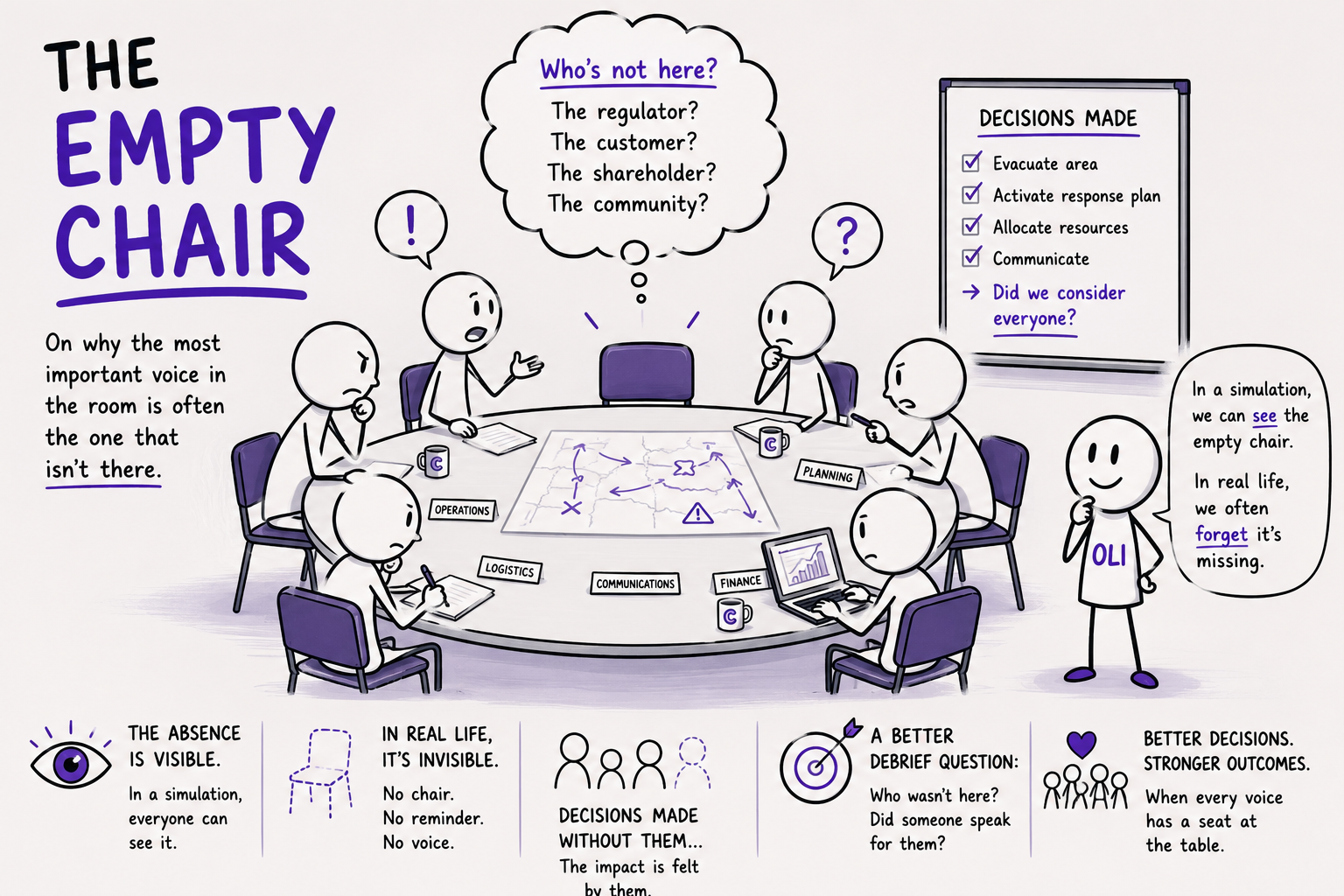
Absence is data. Most rooms don’t log it.
Someone raised a sharp point after this story first ran: that empty chair often represents the regulator, the customer, the shareholder. The party whose interests are real, whose reaction matters, and who simply isn’t there to argue their own case.
In a simulation, that absence is visible. The chair is physically there. Everyone can see it and account for it. In real meetings, the chair isn’t even pulled up. Nobody marks the seat as empty. We just assume the missing party would agree with us, or we forget to ask the question on their behalf at all.
Across enough debriefs, a pattern shows up. The same handful of seats tend to sit empty, meeting after meeting, decision after decision.
The tragedy isn’t the empty chair itself. It’s what happens downstream of it. The shareholders, the donors, the taxpayers, the customers, they’re the ones who absorb the cost when ‘not important enough to include’ turns out to be the wrong call. The buck stops at the head of the table, whether or not that table remembered to leave a seat.
Next time you review how a decision got made, don’t just ask what was said. Ask who wasn’t there, and whether someone spoke for them anyway. It’s a small change to a debrief. It changes what the debrief is actually for.
A cinten simulation can seat the regulator, the customer, or the board at the table on purpose, as a role, a feed, or an injected constraint. Not as an afterthought.
When a perspective is deliberately left out of an exercise, that’s a design choice you can see, discuss, and defend. Not a blind spot you discover later.
The analytics engine ties every decision back to who was present, and who wasn’t, when it was made. The empty chair becomes part of the record, not a footnote.
Teams that rehearse asking ‘who’s missing’ in a simulation start asking it in real meetings. That habit is worth more than any single scenario.
The most important person in the discussion is often the one who isn’t there.
cinten lets you design exercises where the regulator, the customer, and the dissenting voice are part of the room by design, and shows you exactly what happens to a decision when they are.
One short essay a month on decision-making under pressure. No promotional emails, no recycled posts.